Schedule update: the leaderboard freeze has been further postponed
to August 5, and the final rankings will be
announced on August 6. The paper submission
deadline has been extended to August 9.
Schedule update: the leaderboard freeze has been postponed to
July 29, and the final rankings will be announced
on July 31. The paper submission deadline remains
unchanged on August 3.
Registration is now closed. Thank you to everyone who signed up!
The testing set has been released and the
leaderboard
is now open for submissions. The relevant links have been sent to
the email address you provided in the registration form. Please
check your inbox. If you have any questions, feel free to contact
us at any time.
We have updated the baseline! Please see
GitHub
for details.
Registration is now open! The dataset link will be sent to your
registered email shortly. If you do not receive it, please contact
us immediately via email or WeChat.
The Real-World AVSE Challenge has been accepted by ISCSLP 2026.
Introduction
The Real-World AVSE Challenge focuses on Audio-Visual
Speech Enhancement (AVSE) under genuinely real-world conditions. Unlike
conventional benchmarks built on the "clean video plus additive mixing"
paradigm, it emphasizes naturally occurring speech overlap, authentic
reverberation, and ambient noise, while also confronting the visual
degradations common in practice: occlusion, low quality, missing
frames, blur and far-field. Through two complementary tracks on real-world mixed
scenarios and visual degradation, the Challenge aims to move AVSE from
the "ideal video" setting toward real-world deployment.
This track provides multi-speaker audio-visual data captured naturally in
real environments, with speech mixed organically rather than synthetically.
It offers a comprehensive test of model robustness and practicality in
realistic settings, aiming to bridge the gap between simulation and reality.
Track 2 — Visual Degradation
Built on relevant public datasets, this track constructs a set of visually
degraded samples, covering occlusion, low quality, missing frames, and blur,
to systematically assess how well models hold up when the visual modality
becomes unreliable.
Data
The Real-World AVSE Challenge provides an official
development set and testing set for each track. The provided data falls
into two cases: single-speaker speech and two-speaker simultaneous
speech, and all audio files are naturally recorded. The recordings
involve seven groups of distinct speakers (two per group, with no gender
restriction). For both Track 1 and Track 2, the speakers in the
development and test sets are completely non-overlapping. We place no
restrictions on the training data.
Training Set
This Challenge does not specify any official training set.
Participants are free to use any open-source datasets, as well as
any pre-trained models and data augmentation methods. (Regardless of
which datasets, models, or methods are used, participants must
clearly describe them in the final paper submission.)
Development Set
Track 1
The speech falls into two types. One is mix, which
comes from naturally recorded real-world mixtures; it has no
clean reference, so only non-intrusive (reference-free) metrics
are provided. The other is remix, formed by summing two clean
single-speaker segments, which supports both reference-based and
reference-free metrics. (Both mix and remix contribute to the
final evaluation. remix plays a key role, since its ground truth
makes reference-based metrics possible.) The dev set is drawn
from three of the seven speaker groups.
Track 2
The development set reuses the Track 1 development data, likewise
divided into mix and remix, with visual degradations applied to
the target speakers' face videos. There are five types of visual
degradation: low quality, occlusion, frame freezing,
desynchronization, and blackout. It also includes the original
3-meter far-field visual material from the data. The data comes
from three of the seven speaker groups.
Testing Set
Track 1
The testing set follows the same mixing scheme as the
development set, with data drawn from the remaining four unseen
speaker groups, ensuring no overlap between the development and
testing sets.
Track 2
The testing set likewise reuses the Track 1 testing data, with
visual degradations applied to the target speakers' face videos.
The data again comes from the remaining four unseen speaker
groups, ensuring no overlap between the development and testing
sets.
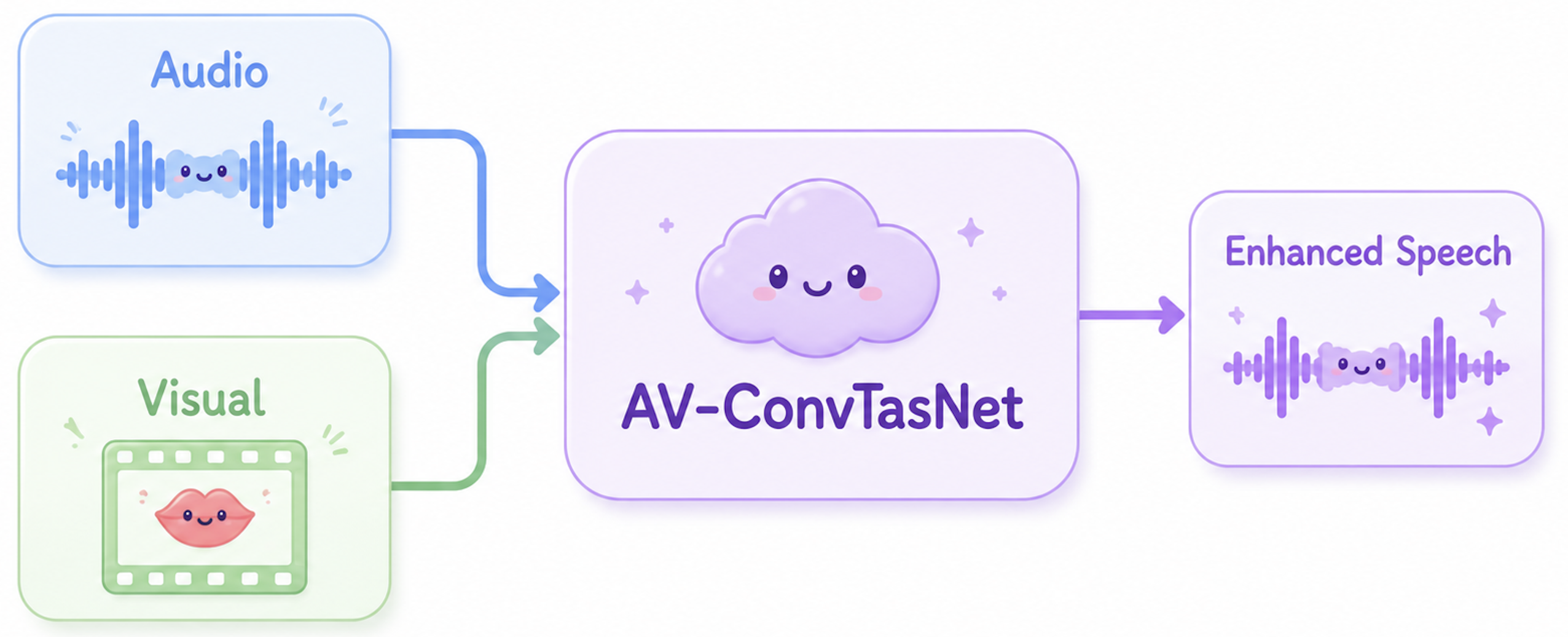
The baseline system is AV-ConvTasNet, a two-stream
audio-visual separator that recovers a single target speaker from a
mixture, conditioned on that speaker's lip movements. The audio branch
is a Conv-TasNet separator operating on the raw waveform, while the video
branch is a frozen ResNet-34 lip-reading encoder (a 3D convolutional
stem followed by ResNet-34). These visual features are temporally
aligned to the audio bottleneck and fused with the audio representation,
allowing the model to use the target speaker's lip video to guide
separation. Given a mixture waveform and the corresponding lip frames,
the model directly outputs the enhanced target speech.
Submissions are assessed with a suite of complementary metrics covering
signal quality, perceptual quality, intelligibility, and speaker
identity. Each metric is computed on the scenes indicated above using
the listed backend.
Metric
Type
Scenes
Backend
SI-SDR / PESQ / STOI
Reference-based
Remix only
torchmetrics
UTMOS
No-reference MOS
Mix + remix
UTMOSv2
DNSMOS
No-reference P.835
Mix + remix
torchmetrics ONNX
CER
Chinese character error rate
Mix + remix
Fun-ASR-Nano-2512
Speaker similarity
Identity preservation
Mix + remix
WeSpeaker ResNet34
Timeline
All dates are tentative and may be subject to change. Times are in
AoE (Anywhere on Earth).
Challenge Registration
Release of Baseline Systems, Training Dataset References, and
Development Dataset (Track 1 and Track 2)
Testing set released and leaderboard submissions open (each team
may submit up to three entries per day)
Registration Closes
Leaderboard Frozen
Announcement of Final Rankings
Paper Submission Deadline
Paper Acceptance Notification
Camera-ready Deadline
Leaderboard
The testing set has been released and leaderboard submissions are now
open. Submissions are scored offline by the organizers
using the full metric suite of the baseline evaluation protocol, and the
official ranking is based on OVRL, the mean of a team's
per-metric ranks (lower is better).